Does the capacity to refuse medical treatment require different abilities in different clinical circumstances?
Three Kinds of Decision-Making Capacity for Refusing Medical Interventions ↗
The American Journal of Bioethics
What ought we to do when caring for patients?
My scholarship in clinical ethics is informed by my work as a practicing clinical ethicist. I explore morally challenging questions that arise in the care of patients, bringing philosophical analysis into conversation with the realities of clinical medicine.
When, if ever, is deception morally permissible in medicine?
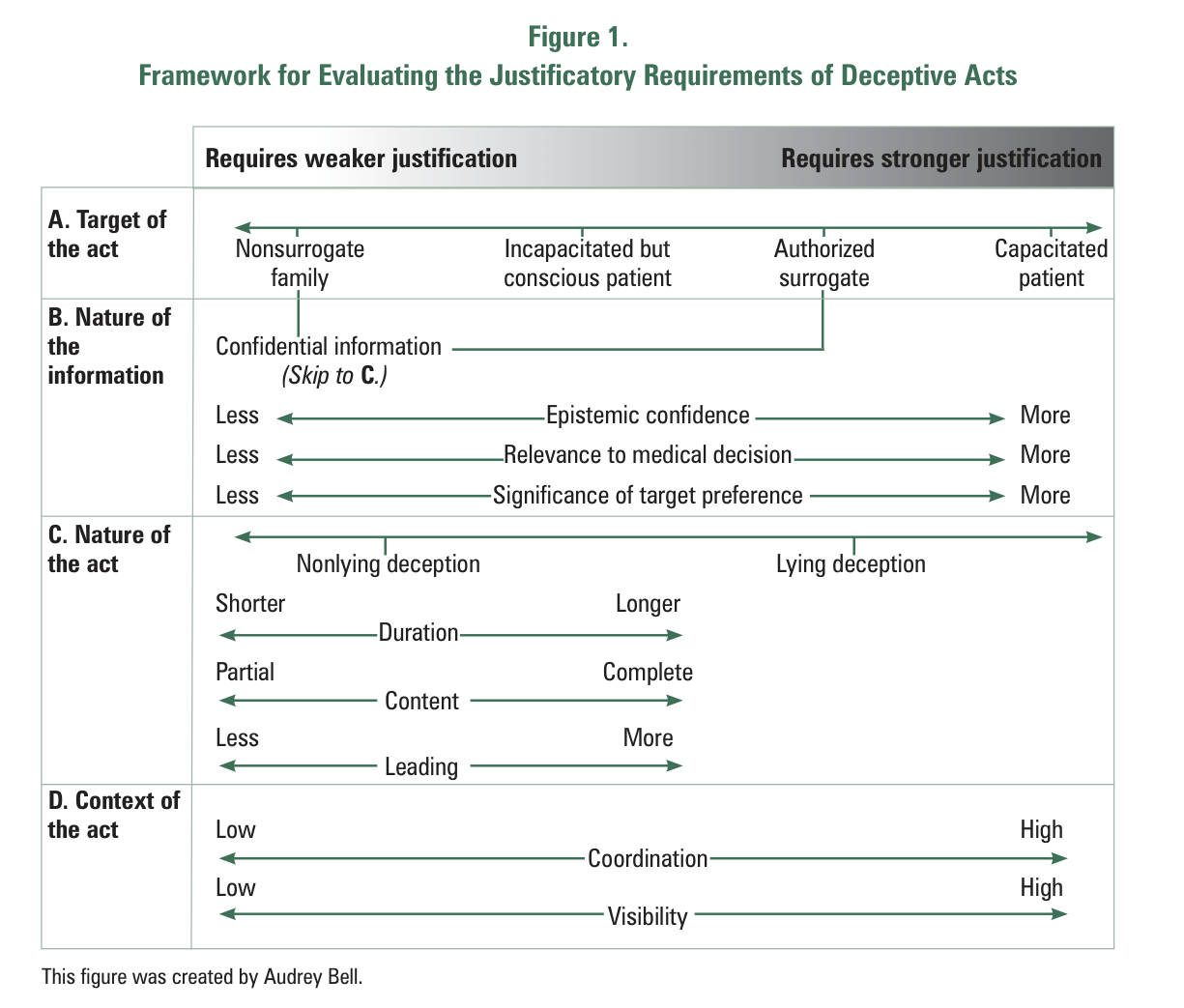
Truth-telling is universally recognized as a strong moral obligation in medicine. Yet ethical guidance to help clinicians and clinical ethicists determine when deception might be morally justified remains surprisingly underdeveloped.
My work with Erica Salter seeks to address this gap by developing a framework for navigating the moral terrain of clinical deception, identifying the morally relevant features of deceptive acts and clarifying what is required to justify them.
How should clinicians allocate scarce pain medication?
My work with Parker Crutchfield and Casey Chmura explores why conventional frameworks for allocating scarce medical resources are inadequate for allocating scarce pain medication. We develop an alternative framework that prioritizes patients’ self-reported pain rather than medical prognosis.
Among the questions this research explores:
A collection of philosophical inquiries arising from the practice of medicine, drawing on research articles and case commentaries.
Three Kinds of Decision-Making Capacity for Refusing Medical Interventions ↗
The Case for Baptizing a Dying, Unconscious Atheist ↗
Fostering Medical Staff Reflection on the Technological Alienation of Parents in the NICU ↗
Publication links currently lead to title searches in Google Scholar.